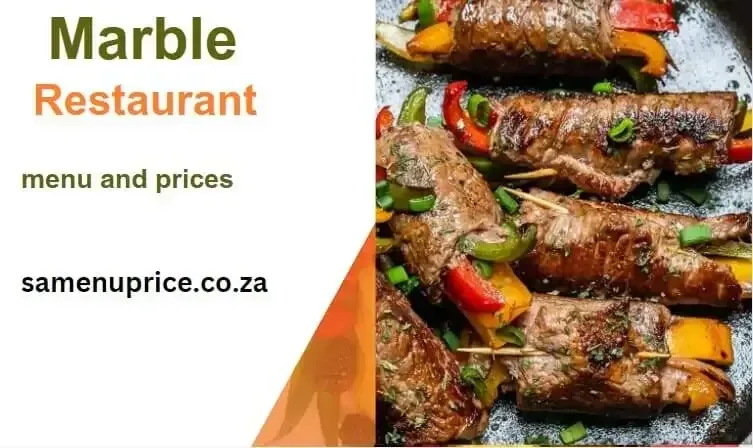
Marble Johannesburg is an open-fire restaurant in Rosebank where meat, seafood and vegetables are cooked over flame and coal. It sits in the premium dining range. On the sample menu updated on 30 June 2026, starters were roughly R125 to R275, composed main courses R275 to R550, South African signature steaks R695 to R1,595, and imported premium cuts as high as R3,490. A meal with drinks can therefore vary enormously.
This guide was reviewed in September 2026. Marble describes the menu as a sample that may differ from what is served on the day. Seasonal produce, available cuts and market supply can change. Use these prices to choose a budget and compare sections, then confirm the current menu, steak weight and final price when you book or order.
Marble Johannesburg prices at a glance
| Menu section | June 2026 sample range | Useful budget note |
|---|---|---|
| Starters and salads | R125 to R275 | One starter can often be shared |
| Composed mains | R275 to R550 | Accompaniments are built into the dish |
| Meal for two: grilled meat | R1,390 | About R695 each before drinks |
| Meal for two: fish and shellfish | R1,590 | About R795 each before drinks |
| South African signature steaks | R695 to R1,595 | Weights and included sides vary |
| USDA and American Wagyu cuts | R1,490 to R3,490 | Premium imported selection |
| Extra sides | R75 to R95 | Check what the main already includes |
| Desserts | R105 to R140 | Cheese selection was R265 |
These are food prices from a dated sample menu. Wine, cocktails, water, coffee and service are additional. A diner choosing a composed vegetable main and one drink has a very different bill from a table ordering imported Wagyu, several starters and wine. Decide which experience you want before treating one average price as meaningful.
How the Marble menu is organised
The menu moves from small opening dishes to composed mains, sharing specialities, South African signature steaks, imported premium beef, sides and desserts. The open fire is the common thread. That does not mean every plate tastes smoky. Fire may be used to char a vegetable, roast fruit, grill meat or build a sauce.
Composed mains arrive with their planned garnishes and sauces. Signature steaks focus on a particular producer, cut and weight. The imported section pushes further into luxury beef. If you want a complete plate without many decisions, use the composed mains. If the cut itself is the occasion, compare the steak sections.
Read each description rather than ordering by ingredient alone. A fillet main includes goat’s cheese, root vegetables and cranberry jus, while a plain signature cut may need sides. A salad can include bacon, anchovy, nuts or cheese. The detailed ingredient list helps you avoid a flavour or allergen that changes the whole dish.
Starters and small plates
“Something to nibble” was R145 and combined hummus, baba gannouj and smoked olive tapenade. It is a practical table opener because it offers several flavours without starting with a full meat portion. Ask what bread or crisp element accompanies it and whether more is available at an extra charge.
Overnight coal-roasted soup changed daily and was R135. A daily dish needs a fresh description: ask for the main ingredient, stock and garnish. French onion soup was R160 with Gruyère and Emmenthal croutons, making it the richer and more predictable soup choice.
Asparagus was R195, paired with cucumber, goat’s cheese, tomato and olive ragout, and truffle oil. Pear was R155 with Gorgonzola, saffron, lemongrass, fennel and walnut bread. These dishes show how the starter section uses vegetables and fruit with cheese, nuts and fire rather than treating them as plain sides.
Marble Avo Ritz was R195 and used coal-fired prawn tails, avocado and prawn mayonnaise. Lobster mosaic was R245, while octopus was R235 and barbecue calamari R195. Seafood starters can make sense before a meat main, but diners with shellfish allergies need to discuss shared surfaces and sauces directly.
Marble Bites cost R235 and offered a mixed grill selection such as lamb ribs, peri-peri chicken wings, short-rib magwinya and a game skewer. It is useful for two people who want a broad preview. Confirm the current pieces because a seasonal sample description may change.
Steak tartare was R225, kudu R195, quail R225 and snails R190. Tartare involves raw or minimally cooked beef elements, while cured kudu uses preservation rather than ordinary grilling. Ask about preparation if raw, cured or game meat is unfamiliar or unsuitable for you.
Salads are not all light or meat free
Burrata salad was R275 with fruit, focaccia, almonds and herbs. Its cheese and bread make it substantial. Marble Caesar salad was R195 and included pancetta and anchovies. Cobb salad was R175 with chicken, bacon, mature cheddar, egg and avocado. Neither Caesar nor Cobb is a vegetarian salad.
Super Salad was R185, combining fired cauliflower, grains, seeds, pomegranate, cucumber, herbs and tahini. Grilled chicken could be added for R95 or sirloin for R135 on the sample menu. This makes the base salad the clearest plant-focused choice, subject to current dressing and kitchen practices.
A salad can work as a starter for the table or a main for one person. Ask about portion size before adding protein. Adding sirloin brings the sample price to R320, which moves it into main-course territory. A shared burrata starter can cost less per person but has a different purpose.
Composed meat mains
Pork belly was R335 with chorizo and apple bean stew, baby gem, cashew, mustard dressing, roasted apple and crackling. It layers pork in several forms and includes nuts. It is a rich plate that probably does not need a heavy starter.
Pepper-crusted beef fillet was R455 with goat’s cheese, maple-roasted root vegetables and cranberry-thyme jus. Rib-eye was also R455, with potato, Jack Daniel’s pepper cream, mushrooms, garlic and parmesan. The fillet leans towards tenderness and sweet-savoury accompaniments; rib-eye offers more marbling and a creamy, earthy plate.
Lamb cutlets were R455 with harissa aubergine, olives and goat’s cheese. Game was R375, combining grilled loin with slow-cooked shoulder ragout, pastry, sweet potato, chutney and carrot. The game plate gives two preparations of the meat, making it useful for someone who wants to explore rather than order a single grilled cut.
Sirloin was R385 with smoked-oil potato, onion, mushrooms, chilli jam and Brussels sprouts. It was among the more accessible beef mains on the sample menu and arrived as a finished dish. Compare it with the signature steak prices before assuming the steak section is necessary.
Baby chicken was R335 with sesame, Korean chilli, Szechuan spice, yuzu-pickled cabbage and sweet potato. Duck was R550 with breast, confit leg, miso pear, bok choy and ragout. Chicken offers a sharper, spicier profile; duck is the more elaborate and expensive poultry choice.
Fish and seafood mains
Seabass was R445 with tomato, avocado, potato, olive, basil and lime. Salmon was R465 with scallop and lemongrass cream, caviar, root vegetables, kale and pickled radish. The salmon contains more shellfish-related components than its title alone suggests.
Lobster risotto nero was R545, using lobster, squid ink, fennel, leek, lemon and dill. “Nero” refers to the dark squid-ink preparation. It is a seafood-heavy rice dish and unsuitable for shellfish avoidance.
The fish and shellfish speciality for two was R1,590. It included prawns, calamari, octopus, line fish, lime rice, shellfish butter and greens on the sample menu. At R795 per person before drinks and service, it is an occasion choice. Confirm the day’s fish and exact components.
Fish cooking preferences are not handled exactly like steak temperatures. Ask how the kitchen serves salmon or line fish if doneness matters. Pregnant diners and people with medical concerns should use professional guidance for raw or undercooked seafood.
Vegetarian main courses
Fennel and lemon risotto was R275 with artichoke and basil oil. Miso-glazed pumpkin was R275 with mushroom and barley risotto, ginger, lime, honey and seeds. Josper cauliflower was also R275, with quinoa, apple, celery, tamarind, coriander and curry leaf crumble.
These are composed dishes rather than a collection of sides, which gives a vegetarian diner a comparable main-course experience. They may still contain dairy, honey, gluten or other ingredients. “Vegetarian” does not mean vegan, and shared fire equipment can matter to strict diners.
Choose fennel risotto for a creamy, citrus-led plate; pumpkin for sweetness, miso and earthy mushrooms; cauliflower for spice, texture and a less dairy-forward impression. Ask for the current vegetarian menu because Marble says it changes with seasonal produce.
South African signature steaks
The signature section names producers and gives cut weights. This lets diners compare origin, marbling and scale rather than only “steak”. Silent Valley Wagyu rib-eye was listed at R1,595 for 400g, while a 300g sirloin example was R1,275. These are premium South African Wagyu choices.
Chalmar beef options included an 800g prime rib and 800g T-bone at R695, plus a 1kg wet-aged tomahawk at R945. The bone is included in those weights. A large bone-in steak can suit sharing, but the edible amount is lower than the headline weight.
Ask what sides and sauces come with a signature cut. If none are included, add R75 to R95 for each extra side based on the sample menu. A steak that looks cheaper than a composed main may finish at a similar total after accompaniments.
For sharing, agree on cooking temperature before ordering. A thick steak cannot be divided into rare and well-done halves with the same precision as two individual cuts. If diners have different preferences, separate steaks are safer.
Imported USDA Prime and American Wagyu
The imported section is the highest-priced part of the menu. A 1.2kg USDA Prime tomahawk was R3,490. A 340g boneless Prime rib-eye and 230g filet mignon were R1,590 each. American Wagyu flat iron and flank were R1,490, while a 230g cap of rib-eye was R2,390.
These prices reflect producer, import cost, grading, marbling and scarcity, not just weight. The R2,390 cap of rib-eye costs far more per gram than the large local bone-in cuts. Order it for the specific cut and marbling experience, not as a way to maximise quantity.
Prime and Wagyu are different descriptions. USDA Prime is a high American beef grade. American Wagyu refers to cattle with Wagyu heritage and strong marbling, often crossbred. Neither term alone tells you the exact eating experience; cut, cooking and grade still matter.
Ask the server to show or explain the available cut, weight and recommended doneness. Confirm the price before the order goes to the kitchen. Premium cuts may be limited, and substitutions should never be assumed to have the same price.
Sharing specialities
The grilled meat selection for two was R1,390 and included fillet, sirloin, lamb cutlets, fries and sauces. At about R695 per person before drinks, it provides several meats without entering the imported-steak price band. It is useful when both diners want variety.
The seafood selection for two cost R200 more. Choose between them based on preference, not only price. The meat platter suits a table comparing cuts. The seafood platter gives several species and preparations with rice and greens.
“For two” assumes a typical appetite and no large number of starters. A table that orders several opening plates may find the speciality generous. Very hungry diners may add a side. Ask the server about current portion and included accompaniments.
Sides, sauces and additions
Marble fries were R75, salad and mixed vegetables R85, and bone marrow R95. These were extra side prices. Composed mains already include planned elements, so an extra side is often unnecessary unless sharing.
Fries offer the simplest accompaniment to steak. Mixed vegetables make sense when the main lacks greens. Salad adds acidity and freshness. Bone marrow is rich and adds meat flavour, but it is not a conventional side for volume.
Ask whether sauces are included with a signature steak or charged separately. A large cut with two sides and sauce can add several hundred rand to the table. Review the full order before adding a second starch.
Desserts and cheese
Ice-cream sandwiches were R105 and offered different combinations such as churro, milk-and-cookie or fruit and meringue. Other desserts were generally R140, including honey butter toast, pavlova, sticky chocolate pudding, pecan and pumpkin, raspberry yuzu, and pistachio cheesecake.
Honey butter toast is rich and shareable. Pavlova or raspberry yuzu brings fruit and sharper acidity. Sticky chocolate pudding is the warm, dense choice. Pistachio cheesecake contains nuts and dairy, while pecan dessert clearly contains nuts.
The local cheese selection was R265 with pickles and preserves. It can replace sweet dessert and may be shared. Ask which cheeses are included and whether bread or crackers come with it.
Estimating your bill
A lower-priced three-course route could combine a R145 starter, R275 vegetarian main and R105 dessert for R525 before drinks and service. One starter shared between two would reduce the per-person food cost.
A composed steak dinner might include a R195 starter, R455 fillet and R140 dessert, totalling R790 before beverages and service. Add a cocktail, wine or bottled water and the final figure moves higher.
The grilled-meat platter for two starts at R695 per person. Adding one shared starter at R235 and two desserts at R140 brings food to R1,905 for the table, or R952.50 each. Imported cuts can exceed that total before any other course.
Allow for service according to the bill and group policy. Large bookings may have set-menu, deposit or automatic service conditions. Read the booking terms rather than assuming the same rules as a table for two.
Bookings, location and practical details
Marble Johannesburg is at Trumpet on Keyes, at Keyes and Jellicoe Avenue in Rosebank. Confirm the correct city because the brand also has other dining activity. Use the address attached to your reservation.
Book ahead for evenings, weekends and celebrations. State dietary needs when booking, then repeat them to the server. A note in an online form is helpful but does not replace a kitchen conversation.
Ask about dress expectations, parking and accessibility if these affect your visit. Opening times can change for holidays and private events. The reservation confirmation is more reliable than an old hours table.
Allergens and dietary requirements
The menu uses dairy, egg, gluten, sesame, soy, nuts, fish and shellfish across many dishes. Sauces and garnishes can contain allergens that are not clear from the title. Shared grills and preparation areas create cross-contact risk.
Tell the restaurant the specific allergy and severity before ordering. Ask them to check the current recipe. Removing a visible garnish does not remove an ingredient already used in a sauce or marinade.
Vegetarian diners should request the current vegetarian menu. Vegan diners need more specific checks because honey, cheese, butter and shared equipment appear in plant-focused dishes. Religious dietary requirements also need direct confirmation of sourcing and preparation.
How to choose well at Marble
Three practical ordering plans
For a first visit with a controlled budget, share “Something to Nibble”, choose two composed mains, and decide on dessert after eating. Using the sample prices, the R145 starter plus two R275 vegetarian mains would total R695 before drinks and service. Replacing those mains with sirloin and seabass would bring the food subtotal to R975. This plan gives the table the open-fire style without relying on the premium steak list.
For two diners focused on meat, compare the R1,390 grilled selection with two separate mains. Fillet and rib-eye at R455 each, plus two R75 fries, would total R1,060 on the sample menu. The platter costs more but provides fillet, sirloin, lamb, sauces and a shared presentation. Separate mains give each diner control over cooking preference and accompaniments.
For a celebration built around steak, choose the cut first and price the entire plate before adding starters. A R945 local tomahawk plus two sides at R85 would be R1,115 before sauces, drinks and service. The R3,490 imported tomahawk changes the scale of the bill completely. Both may look like “tomahawk” on a menu, but producer, origin, grading and weight place them in different price categories.
Questions for the server
- Is the June sample dish still on today’s menu?
- What cut and exact weight are available?
- Does the steak include a side or sauce?
- Is the listed weight bone-in?
- Which dishes contain nuts, shellfish or alcohol?
- Can the sharing steak suit two different cooking preferences?
- Are there set-menu or deposit terms for our booking?
These questions matter because a seasonal fine-dining menu is not a fixed catalogue. A vegetable garnish can change with supply, while a steak substitution can change both weight and price. Ask before the kitchen starts rather than challenging an expected price at the end.
Lunch, dinner and bar choices
The main restaurant and bar menu serve different purposes. Bar snacks can suit a drink and a shorter visit, while the dining-room menu is structured for full courses and premium cuts. Confirm which menu applies to the table you book. A dish seen on the bar page may not be offered as a dining-room main, and its price can differ.
Seasonal lunch or event menus may offer a set number of courses at a fixed price. Compare what is included, the available booking times and cancellation terms. A set menu can make budgeting easier, but it limits choice. The à la carte menu gives more control over dish selection and can be cheaper when you want only one course.
Choose a composed main when you want the kitchen’s complete plate and a predictable food total. Choose the South African signature section when producer, cut and weight matter. Use the imported selection only when that specific beef experience justifies the much higher price for you.
Share one starter if a large steak or platter is coming. Check inclusions before adding sides. Ask for current prices on any seasonal or substituted dish. Decide on wine after the food order so the drink supports the meal and budget.
The June 2026 sample menu gives a useful picture of Marble’s pricing, but the restaurant explicitly says dishes may differ on the day. Confirm the live menu, available cut, exact weight and price before ordering. That is especially important for premium steak and seafood, where one change can shift the bill by hundreds or thousands of rand.
More menu images